
Why You Should Track Your Banjo Practice
Oct 28, 2026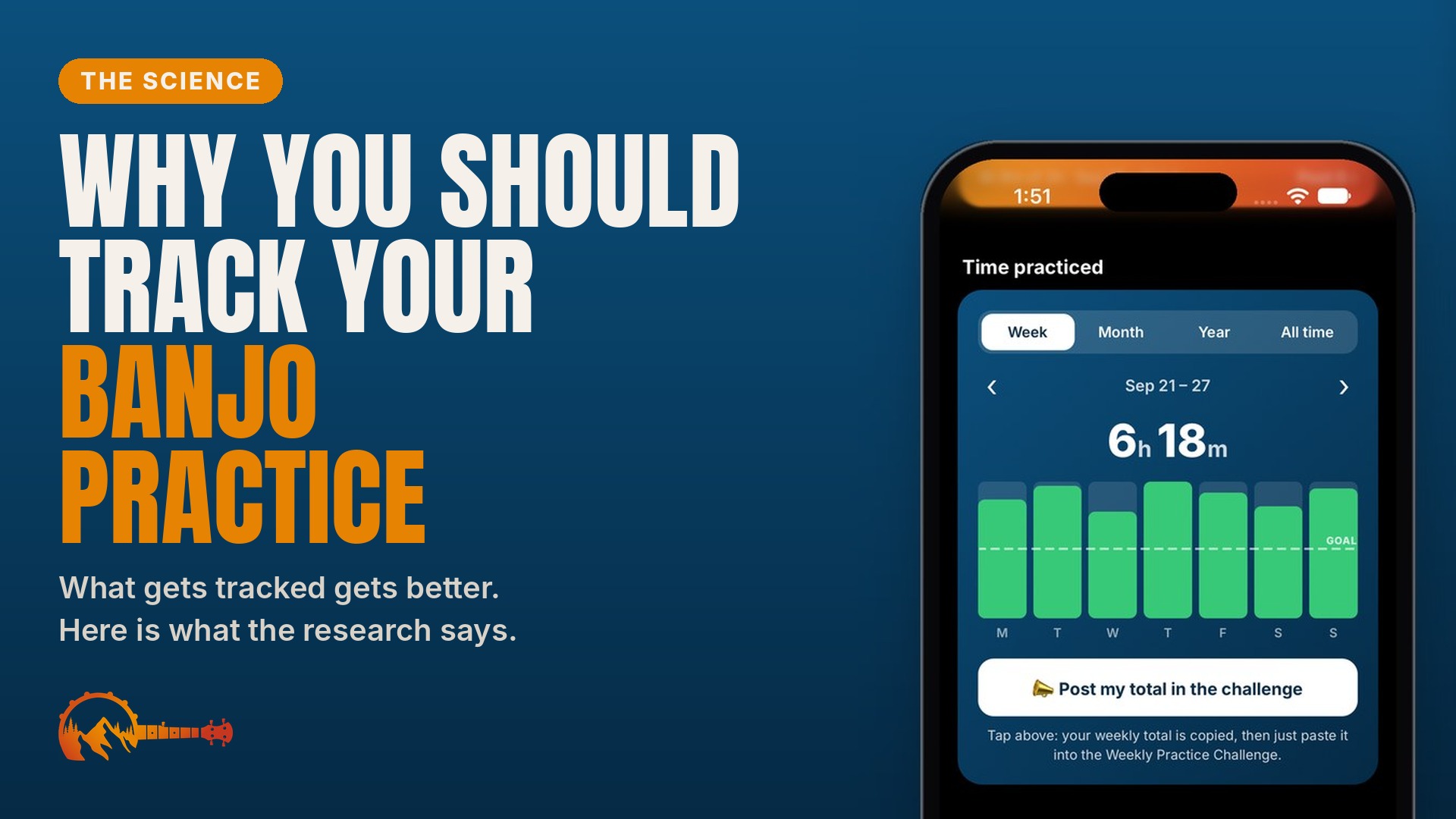
Want to practice more? Start tracking your banjo practice. It sounds too simple to work, but research shows that just keeping track of something changes how you do it.
What Gets Tracked Gets Better
Think about the bathroom scale. In one study, people who weighed themselves every day lost about 13 pounds more over six months than people who weighed in less often.1 The scale didn't change their bodies. Seeing the number every morning changed their choices. Other weight-loss studies show the same pattern.2
It isn't just weight. A review of 138 studies found that people who track their progress are more likely to reach their goals, especially when they write it down and track often.3
For banjo, that means tracking your practice time. You can't measure "getting better" day to day, but you can measure the minutes you put in, and the minutes are what make you better.
Why Tracking Works on Your Brain
Your brain loves seeing progress. The brain's reward system doesn't just fire at the finish line. It ramps up as you get closer to a goal.4 A growing streak or a weekly total gives your brain that "getting closer" feeling every day.
Closer goals pull harder. In one study, coffee shop customers with a "buy 10, get one free" card came back more and more often as they got close to the free coffee.5 When you can see your progress, you want to keep it going.
Small wins keep you going. In a study of 12,000 daily diary entries, making progress, even small progress, was the biggest thing that made people feel motivated.6 A practice log is a record of small wins.
Repetition turns practice into a habit. Do something every day and your brain eventually runs it on autopilot.7 In one study, that took about 66 days on average.8 Tracking keeps you showing up until the habit takes over.
Your brain keeps practicing while you sleep. In one study, people got about 20% better at a finger-tapping skill after a night's sleep, with no extra practice.9 Every day you play gives your brain another night to lock it in. Over the years, practice even reshapes the brain's wiring.10
Track it without thinking about it: the free Banjo Mountain app has a practice timer built in. Tap start when you pick up the banjo, and it logs your time, builds your streak and adds up your week.
Streaks Work, but Don't Let One Miss Stop You
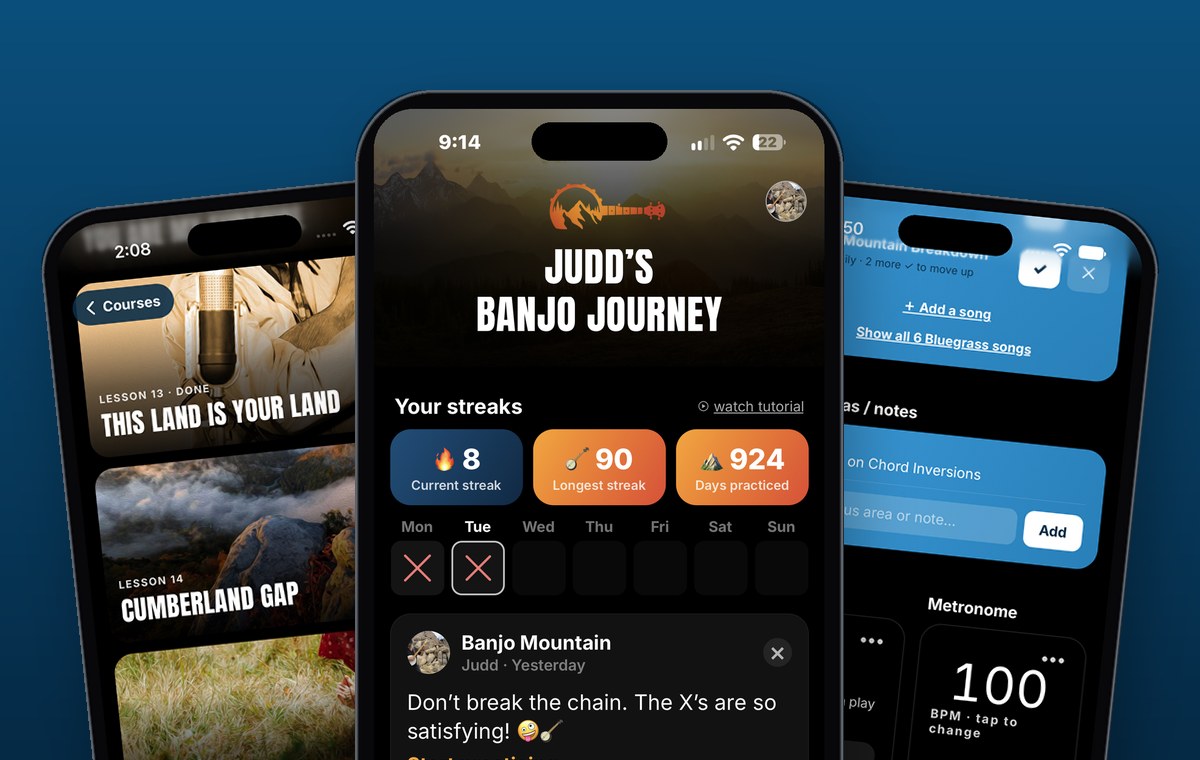
Streaks are a great motivator. But research on streaks found a catch: when people break one, many quit altogether.11
Don't let that be you. The habit study found that missing one day barely matters. It's missing several in a row that hurts.
That's why the practice timer in the Banjo Mountain app gives you one free day every week. Life gets busy, and one missed day won't break your streak. The point isn't to be rigid about practice. It's to get your momentum going and keep it going.
So if you miss a day, just don't miss two.12 And on busy days, use the 5-minute rule: five minutes keeps the streak alive.
How to Track Your Banjo Practice
- Time every session. Even 5 minutes counts.
- Jot down what you worked on. A roll, a song, a lick. One line is plenty.
- Check your weekly total. Seeing it grow is the motivation.
- Share it. Tracking works even better when others see it. That's why we run a weekly practice challenge.
- Never miss twice. Missed a day? Five minutes today and you're back.
Wondering how much to practice? See How Often Should I Practice Banjo to Improve? And start every session with a quick banjo warm-up.
Quick Answers
Does tracking practice really help?
Yes. Tracking makes you practice more often, and steady practice is what makes you better.
What should I track?
Your minutes, the days you play, and a quick note on what you worked on.
What if I break my streak?
Pick up the banjo the next day, even for 5 minutes. The practice timer in the Banjo Mountain app gives you one free day a week, so one missed day won't break your streak.
Keep Reading
- The 5-Minute Rule: How to Practice Banjo Consistently
- Learn More Banjo Songs with Practice Buckets
- How Long Does It Take to Learn Banjo?
Start Tracking Today
What gets tracked gets better. The free Banjo Mountain app makes it easy: a practice timer, a daily streak, your weekly total and a weekly practice challenge. Plus free beginner lessons, a tuner and a metronome.
Get the free Banjo Mountain app
Sources
- Steinberg et al. (2015), "Weighing every day matters," Journal of the Academy of Nutrition and Dietetics
- Burke, Wang & Sevick (2011), "Self-monitoring in weight loss: a systematic review," Journal of the American Dietetic Association
- Harkin et al. (2016), "Does monitoring goal progress promote goal attainment?", Psychological Bulletin
- Howe et al. (2013), "Prolonged dopamine signalling in striatum signals proximity and value of distant rewards," Nature; see also Schultz, Dayan & Montague (1997), "A neural substrate of prediction and reward," Science
- Kivetz, Urminsky & Zheng (2006), "The goal-gradient hypothesis resurrected," Journal of Marketing Research
- Amabile & Kramer, The Progress Principle, Harvard Business School
- Martiros, Burgess & Graybiel (2018), habit formation in the striatum, Current Biology
- Lally et al. (2010), "How are habits formed," European Journal of Social Psychology
- Walker et al. (2002), "Practice with sleep makes perfect," Neuron
- Bengtsson et al. (2005), "Extensive piano practicing has regionally specific effects on white matter development," Nature Neuroscience
- Silverman & Barasch (2023), "On or off track: How (broken) streaks affect consumer decisions," Journal of Consumer Research
- James Clear, Atomic Habits, and his guide to habit tracking


